If you have misaligned teeth, you’ve probably thought at least once: how nice would it be to straighten them without braces? Today, many patients prefer clear aligners for teeth straightening. The main reason is the ability to move teeth while the process remains invisible.
What Are Clear Aligners?
These aligners gently apply force to the teeth to gradually move them into the desired position. They’re made of thin, transparent plastic, smooth to the touch, and comfortable to wear. They resemble whitening trays or retainers used after fixed braces therapy. What makes this method stand out compared to braces with brackets, wires, and rubber bands is the fact that aligners are invisible on the teeth.
How Do Clear Aligners Work?

Aligners are custom-made for each patient based on a dental impression. An orthodontist analyzes the teeth and creates a treatment plan, determining the final position for each tooth. The aligners are then made to match the next step in the plan, gradually applying pressure to move the teeth.
The process is gradual and carefully planned, with the teeth shifting little by little into their new position.
How Are Aligners Worn?
During the initial visit to the dental office, the dentist will examine your teeth and review your X-rays. You’ll receive all the basic information about this method of teeth straightening. Then, dental impressions are taken and analyzed. It’s possible to roughly estimate the duration of your treatment. After that, you’ll receive your first set of aligners and begin your orthodontic therapy.
The aligner process is organized into monthly intervals. After finishing the first set, you return to the office, a new impression is taken, and you receive the next set of aligners to continue moving your teeth. This cycle repeats monthly until the desired results are achieved.
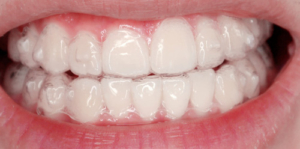
When you first put in a new aligner, you’ll feel increased pressure on your teeth. Over time, as your teeth shift, this pressure will ease. You’ll notice that your teeth now fit the new position, and it’s time to move on to the next aligner. Your orthodontist monitors this progress monthly and plans the new positions for each tooth.
How Many Hours Per Day Should You Wear Aligners?
Aligners should be worn both day and night. You must remove them while eating or playing sports. Ideally, you should wear them the rest of the time—around 22 hours per day. The more consistently you wear your aligners, the faster your teeth will straighten.
Who Are Clear Aligners For?
Because aligners aren’t worn 24/7 and the pressure applied is moderate, they are best suited for mild to moderate orthodontic cases. Severe anomalies are still best treated with fixed braces. Depending on the severity of the misalignment, aligners may be worn for 6 to 18 months. In some cases, aligners are used in combination with fixed braces—severe cases may be initially treated with braces, followed by aligners to finish the therapy.
What Are the Pros and Cons of Aligners?
The biggest advantages of aligners are comfort and aesthetics. They are virtually invisible on the teeth, and you can speak normally while wearing them. Eating is easier compared to braces, where food often gets stuck on the brackets. Oral hygiene is more straightforward—you simply brush your teeth after removing the aligners, and the aligners themselves are easy to clean with a toothbrush and toothpaste. If you have a special event, meeting, or celebration, you can remove them for a few hours. During the first few days of wearing a new aligner, you may feel some pressure and mild discomfort, but not the pain associated with traditional braces.
The downsides are limited indications and the fact that not every case can be treated with aligners. Also, wearing them consistently throughout the day requires discipline. This is important to understand before starting therapy so you don’t expect results from wearing them only a few hours a day.
The fast-paced lifestyle we live today often deters patients from getting traditional braces. Reasons vary—from aesthetics to professional obligations. Visit your dentist to find out if clear aligners are the right solution for you.